The Joke You Missed Is Still a Clue: Meiko Haigou’s Six Rules for Japanese VA Panels
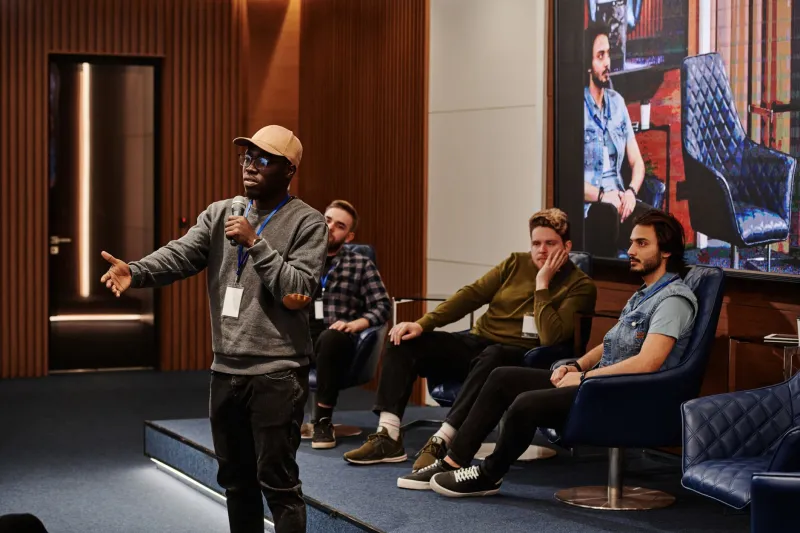
You’re in the third row at a packed convention panel. The voice actor onstage says something, the interpreter leans into the mic, and the room laughs half a second later. You laugh too—not because you understood the joke, but because the energy is contagious. Then comes the follow-up, and you’re lost again.
Meiko Haigou knows that feeling from the other side of the stage. “I can see the audience trying to keep up,” she says. “And I can see when they give up. That’s the moment I want to fix.”
Japanese voice-acting panels at US conventions are part performance, part translation experiment, and part crowd puzzle. The good news: you don’t need fluent Japanese to have a great time. You need a few habits. Here are Meiko’s six rules for getting more out of the room—even when the punchline takes a detour.
1. Get There Early and Read the Room
Before the panel starts, take thirty seconds to map the stage. Where is the interpreter standing? Can you see the performer’s face and hands from your seat? Is there a screen with names or character art?
Meiko says she does the same thing from her side. “I look at where the interpreter is, how far the mic is, whether the audience can see my mouth. If I’m going to do a character voice, I want them to see the shape of it, not just hear it.”
Sit as close to the center as you can. Avoid the far edges where sightlines to both the guest and interpreter split. If the panel offers an ASL interpreter as well, don’t crowd that sightline—everyone in the room is trying to read a performance.
2. Let the Interpretation Breathe
Live interpreting isn’t a subtitle track. It runs a few beats behind, and it has to make choices. When the room goes quiet after a question, that silence isn’t dead air. It’s the interpreter catching up.
“Sometimes fans jump in with another question before the first one has landed,” Meiko says. “I understand the excitement. But the interpreter is still finishing the thought, and I’m still answering it.”
Count to three before you raise your hand again. If you’re asking a follow-up, keep it short. The more compact your question, the more room the interpreter has to carry your tone—not just your words.
3. Watch the Voice, Not Just the Words
Here’s the secret that makes Japanese VA panels worth attending even when the translation is clumsy: the performance is physical. Pitch shifts. Breath. A tiny pause before a character line. The way a performer switches from a gravelly villain to a bright, high-energy hero in the same sentence.
Meiko often demonstrates this on purpose. “If the joke doesn’t translate, I can still show the rhythm of it. I can show the face. The audience can feel the shape of the character even if they don’t know the line.”
So watch the mouth, the shoulders, the hands. Listen for the moment the voice drops or lifts. You’re not missing the point—you’re catching a different layer of it.
4. Ask Questions That Invite a Story
“What’s your favorite food?” is a convention classic, and it’s fine. But if you want a panel moment that stays with you, ask something that opens a door.
Try: “What’s the hardest line you’ve ever had to deliver?” “How do you find a character’s voice when the director gives you very little direction?” “Which role changed how you listen to your own voice?”
Meiko lights up at process questions. “When someone asks me how I build a character, I can give them a real answer. It’s not just ‘yes’ or ‘no.’ It’s a story.”
Avoid stacking two or three questions into one. The interpreter will have to choose which one to carry, and you may not get the answer you wanted.
5. Laugh With the Room—Not at the Gap
Cultural jokes are tricky. A reference that kills in Tokyo might land as a polite blink in Los Angeles. That doesn’t mean the joke failed. It means the room is doing live translation of its own.
“I can tell when the audience is with me and when they’re waiting,” Meiko says. “The waiting is okay. What I don’t want is for people to feel stupid because they didn’t get it.”
If you miss a punchline, don’t shout for an explanation mid-story. Laugh with the room if the room laughs. Watch the performer’s face. Often the expression tells you whether the line was mischievous, dramatic, or self-deprecating. Save the “wait, what did that mean?” for the autograph line or a fan meetup afterward.
6. Treat the Interpreter as a Scene Partner
The interpreter is not a vending machine for words. They’re performing in real time, making judgment calls, and trying to preserve tone, humor, and timing. When you thank the guest, thank the interpreter too.
Meiko notices. “The interpreter is carrying half the panel,” she says. “When the audience appreciates them, the whole room gets warmer.”
Don’t talk over the interpreter. Don’t ask the guest to repeat something just because you want a cleaner quote for social media. And if you’re recording, check the panel rules first—some guests and interpreters are fine with photos, some aren’t.
The Real Goal Is Connection
You don’t have to catch every word to be a good audience. You have to stay curious. Watch the performance. Give the translation room. Ask better questions. And remember that the joke is a doorway, not the whole house.
“I want people to leave feeling like they met me,” Meiko says. “Not like they read a transcript of me.”
That’s the trade. You bring your attention. The room brings the rest.